
/
/
LED Bird Flight Diverter
The LED Bird Flight Diverter.
Active Visibility, Day and Night.
A solar-charged bird flight diverter with six high-intensity blinking LEDs per face, engineered for 24-hour protection on the highest-risk spans in your network — Great Indian Bustard corridors, nocturnal migratory crossings, and any conductor where passive visibility alone is not enough.
Runtime / Charge
100h+
solar, auto-cutof
Working Principle
A Daily Cycle of
Charge, Detect, Illuminate.
The LED Bird Flight Diverter operates on a fully autonomous daily cycle, requiring no manual intervention once installed. Through daylight hours, the integrated solar panel charges the onboard battery. As ambient light falls at dusk, an integrated light sensor triggers the LED array automatically — no scheduled switching, no manual reset.
The blinking pattern is designed for maximum bird-visible contrast against the night sky rather than continuous illumination, which extends runtime substantially compared to a steady-on LED while maintaining the same detection distance for approaching birds. At dawn, rising ambient light triggers automatic cutoff, and the charge cycle begins again.
The solar panel charges the Li-Ion battery through all daylight hours, including diffuse light on overcast days.
A light-sensitive trigger switches the LED array on as ambient light falls, with no manual timer to set or reset.
A pulsed rather than steady-on pattern maximises bird-visible contrast against the night sky while extending runtime.
Rising ambient light at dawn switches the LEDs off automatically, protecting the battery and resetting the charge cycle.
Under the Housing
Three Systems,
Working as OneDevice
The LED Bird Flight Diverter combines a charging system, a light-emitting system and an energy storage system inside one UV-stabilised, IP-rated housing — each engineered to the specific demands of unattended, live-line service.
Solar Charging
A monocrystalline solar panel integrated into the top housing charges the battery through all daylight hours, sized to fully recover charge within a single clear day even after several consecutive overcast days.
Panel Type
Monocrystalline
Charge Control
Auto-cutoff regulator
Sealing
IP65 rated
LED Visibility
Six high-intensity orange and white LEDs per face blink in a high-contrast pattern optimised for bird-visible detection distance, positioned to project light across the full width of the flapper assembly.
LEDs Per Face
6 (orange/white)
Pattern
High-contrast blink
Activation
Automatic, light-triggered
Battery Technology
A sealed Lithium-Ion cell stores charge for extended runtime with low self-discharge, so reserve capacity is retained across multi-day low-irradiance periods common during India’s monsoon season.
Chemistry
Li-Ion
Capacity
3.2V, 500mAh
Runtime
100+ hrs / full charge
Technical Drawing
Dimensioned for
Field Verification
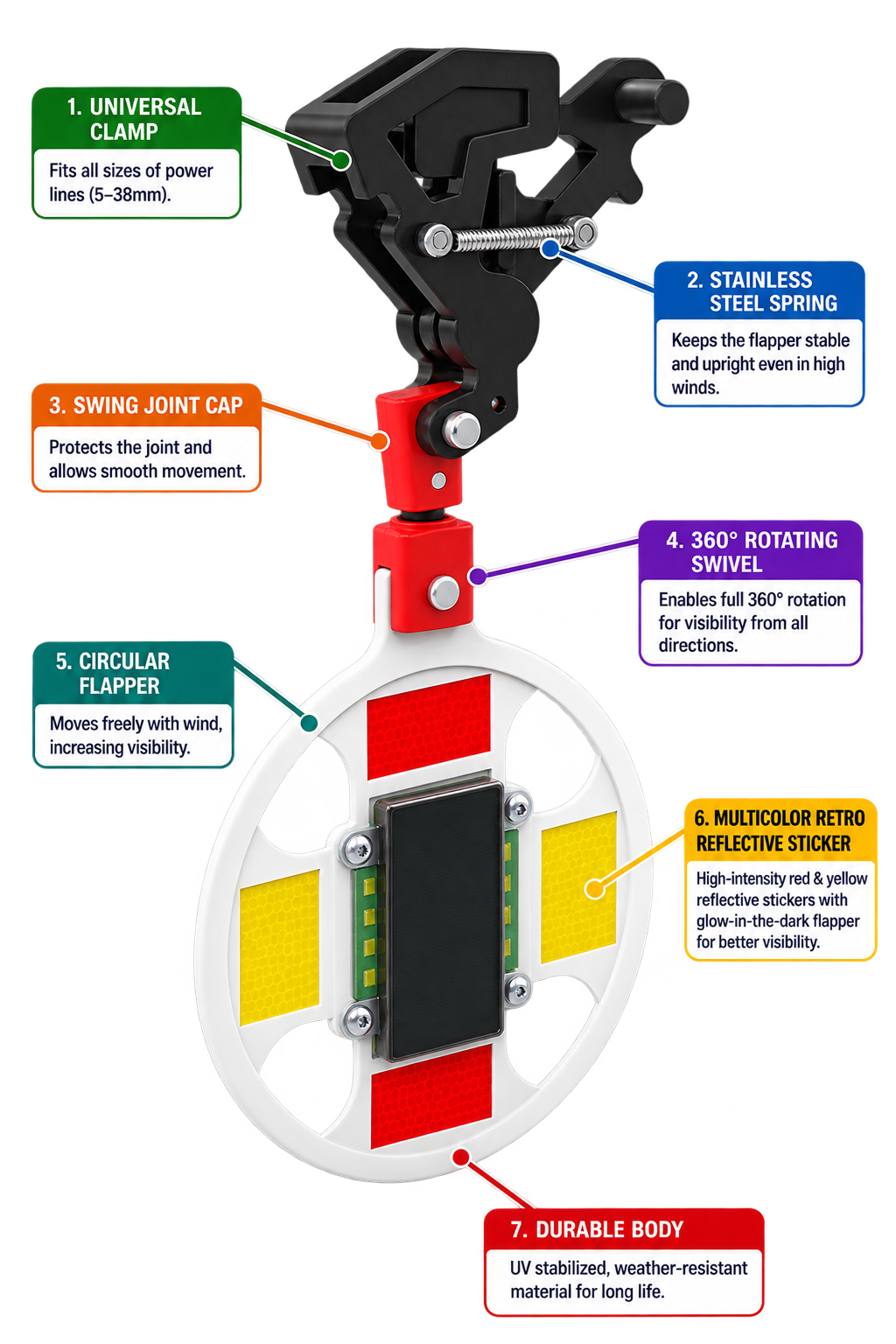
A simplified side-elevation of the LED Bird Flight Diverter assembly, showing the principal dimensions referenced in installation and procurement documentation.
Engineered Performance
LED Bird Flight Diverter
Technical Specifications
| Model Number | PLM/LD-V1 |
| LED Configuration | 6 high-intensity LEDs per face (orange/white) |
| Operating Mode | High-contrast automatic blinking pattern |
| Power Source | Monocrystalline solar panel + Li-Ion battery (3.2V, 500mAh) |
| Runtime Buffer | 100+ hours continuous operation per full charge |
| Activation | Automatic light-triggered dusk-to-dawn sensor |
| Conductor Clamp | 5mm – 38mm universal clamp range |
| Protection Rating | IP65 weather & dust sealed |
| Assembly Weight | < 900g |
| Design Life | 10 Years |
Why These Specifications Matter
A single high-power LED creates a narrow visibility cone. Six lower-intensity LEDs per face give a wider angular spread, so the diverter stays visible to birds approaching from a broader range of flight angles.
Sized well beyond a single overnight cycle so the device continues operating through several consecutive low-sunlight days without a gap in protection.
Prevents overcharge in peak summer sun and deep discharge during extended monsoon cloud cover — both common causes of premature battery failure in unmanaged solar circuits.
The solar panel and battery housing are sealed against dust ingress and low-pressure water jets, appropriate for outdoor, unattended service across India’s full climate range.
The 5mm–38mm universal clamp is shared with the Non-LED and Aero Spin models, so switching specification between models on the same project needs no new hardware.
One Clamp, Every Conductor
Compatible Conductor
& Earth Wire Types
ACSR
Aluminium Conductor Steel Reinforced — the most common transmission and distribution conductor across Indian networks.
AAAC / AAC
All-Aluminium Alloy and All-Aluminium Conductors, common on coastal and corrosion-sensitive sections of the network.
OPGW
Optical Ground Wire combining earth-wire and fibre-optic function, mounted at the top of the tower profile.
Standard Earth Wire
Galvanised steel earth and shield wires along the top of the transmission tower, sharing the same clamp range.
Copper Conductors
Legacy copper conductors on older sub-transmission sections, within the same 5mm–38mm diameter range.
Installation
Hot-Stick Installation,
No Planned Outage
The LED diverter’s clamp geometry is designed for live-line mounting by trained crews using standard hot-stick procedure. The sequence below outlines the standard field process; full procedure documentation is available in the installation guide.
Confirm the mounting point against the site’s diverter spacing plan and identify the conductor or earth wire diameter to verify clamp fit before mobilisation.
Align the solar panel face toward maximum daily sun exposure — generally south-facing across most of India — before final clamp closure.
Position and close the universal clamp on the energised conductor using standard hot-stick tooling, per the crew’s live-line work procedure.
Confirm secure seating and correct clamp closure — rated to withstand over 100kg of pull force without slip — before withdrawing the hot stick.
Where feasible, confirm LED activation at the following dusk cycle as a final field verification that the unit is charging and triggering correctly.
Where LED Is Specified
Reserved for the
Highest-RiskCorridors
Because active illumination adds cost and a maintenance touchpoint that passive models do not carry, the LED diverter is typically specified where nocturnal or low-light risk genuinely warrants it — not applied uniformly across an entire network.
GIB Habitat Corridors
Nocturnal Migratory Routes
Sanctuary Buffer Zones
Ramsar Wetland Crossings
Documentation
LED Diverter
Documentation Downloads
Full technical datasheet with dimensional drawings, electrical parameters and test results.
Download PDFStep-by-step hot-stick installation procedure, including solar panel orientation guidance.
View GuideCommon Questions
LED Diverter,
Answered
Technical questions specific to the LED model — from runtime and monsoon performance to when it’s the right specification.
How long does the LED diverter run on a single charge?
The Li-Ion battery, fully charged via the integrated solar panel, powers the LED array for over 100 hours of blinking operation — comfortably covering several consecutive overcast or low-sunlight days without any gap in nighttime visibility.
Does it keep working through monsoon or extended cloud cover? >
Yes. The 100+ hour runtime reserve is sized specifically to buffer through multi-day low-irradiance periods common during India’s monsoon season, and the auto-cutoff charge circuit protects the battery from deep discharge during extended cloudy spells.
Is the LED model needed on every span, or only high-risk zones? >
The LED model is generally reserved for identified high-risk zones — Great Indian Bustard corridors, nocturnal migratory crossings, and sanctuary buffer areas — with Non-LED or Aero Spin diverters specified across standard spans. All three models share the same universal clamp, so mixed deployment on one line is straightforward.
What is the battery’s expected service life? >
The sealed Li-Ion cell is rated within the unit’s overall 15-year minimum design life and 5-year comprehensive warranty. Low self-discharge chemistry and the auto-cutoff charge controller are specified together to protect battery longevity across that period.
Can the LED diverter be installed on an energised line? >
Yes. The clamp geometry is compatible with hot-stick installation procedures used by trained live-line crews, allowing retrofit deployment on energised conductors without a planned outage.
Get in Touch
Specify the LED Diverter
for Your High-Risk Spans.
Share your corridor risk profile with our engineering team — we’ll confirm whether the LED model, or a mixed deployment across the range, is the right fit for your project.